


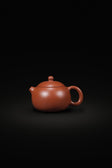
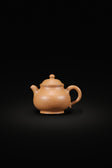





Yixing teapot shapes fall into three broad families: round shapes such as Xi Shi and Long Dan, pear and tall shapes such as Li Xing and Pan Hu, and straight-lined shapes such as Shi Piao, De Zhong and Han Wa. Shape changes how a pot pours, how easy it is to load and empty, and how the leaves sit inside. It matters less than clay and size, so choose those first, then pick the shape you enjoy holding. This guide explains each shape we carry and links to the pots.
What shape actually changes
- The opening. A wide mouth, as on Han Wa, De Zhong and Shi Piao, makes it easy to drop in a chunk of pressed pu-erh and to clear out the spent leaves.
- Room inside. Round and tall bodies give the leaves space to open as they brew. Flat, low bodies spread the leaves out in a thin layer.
- The spout. A straight spout, as on most Shi Piao and De Zhong pots, pours fast and clean. A short curved spout, as on Xi Shi, gives a softer, steady stream.
- The lid. Some lids sit flush with the rim, others sit inside it. Either way, a well-fitted lid stops the flow when you cover the small air hole with a finger.
Many names come with a prefix that tells you how the pot differs from the classic form: Gao means tall, Bian means flattened, Ai means short, and Ming-style follows the proportions of Ming-dynasty pots.
Round shapes
Round pots are the most forgiving to use. The full body lets the leaves open evenly, and most have a short spout and a comfortable loop or inverted-ear handle.
| Shape | The name | What to know |
|---|---|---|
| Xi Shi (西施) | Named after Xi Shi, one of the Four Beauties of ancient China | Plump round body, short spout, small bead knob. One of the best-loved first pots. |
| Bian Xi Shi | Flattened Xi Shi | Lower and wider than the classic Xi Shi, with more room for leaves to spread. |
| Long Dan (龙蛋) | Dragon egg | A smooth egg-shaped body with almost no decoration. Easy to hold and pour. |
| Wen Dan (文旦) | A sweet pomelo | Full, bottom-heavy body tapering to a bead knob. Stable on the tray. |
| Ru Yi Shi Yuan | Round persimmon, a wish that all goes as you hope | Plump, rounded body with a bridge knob. |
| Rong Tian | "Holding the sky," after the round belly of the laughing Buddha | Plump and stable, with a short spout. |
| Duo Zhi (掇只) | Stacked spheres | Built from round and half-round forms set on top of one another. A classic of the round family. |
| Le Gu and Fang Gu | Joyful drum; "after the antique," modeled on a drum | Wide, slightly flattened drum bodies with a wide opening that is easy to load. |
Our round pots: Xi Shi 150 / 200 ml, Xi Shi 250 ml, Xi Shi 200 ml in aged Zini, Bian Xi Shi, Long Dan, Wen Dan, Ru Yi Shi Yuan, Rong Tian, Duo Zhi, Le Gu and Fang Gu.
Pear and tall shapes
These pots are taller than they are wide, with a low center of gravity. The domed space inside suits rolled or tightly pressed leaves that need room to unfurl.
| Shape | The name | What to know |
|---|---|---|
| Li Xing (梨形) | Pear shape | Swells at the base and tapers toward the lid. One of the oldest and most common Yixing forms. |
| Gao Li Xing | Tall pear | A taller pear with more room inside for large leaves. |
| Pan Hu (潘壶) | Named after Pan Shicheng, a Qing-dynasty official and tea lover who ordered this shape from Yixing | Pear-shaped body, domed lid, short neck. A standard of the gongfu tea table. |
| Gao Pan and Ai Pan | Tall Pan and short Pan | The same family, raised or lowered. |
| Shui Ping (水平) | "Level": the spout tip, rim and top of the handle line up on one horizontal plane | A small, balanced pot made for gongfu brewing. A well-made one is said to float upright in water. |
| Nanzhou Gao Shi | A noble scholar | Tall and upright, flaring into a rounded belly on a distinct foot. |
Our pear and tall pots: Li Xing 170 ml, Li Xing 230 ml, Gao Li Xing, Pan Hu 170 ml, Pan Hu 220 ml, Gao Pan, Ai Pan, Shui Ping 130 / 160 ml, Shui Ping 220 ml and Nanzhou Gao Shi.
Straight-lined shapes
Straight lines and flat planes make these pots the hardest to shape by hand and the favorites of many collectors. Most have a wide opening and a straight spout, which makes them practical for pressed pu-erh.
| Shape | The name | What to know |
|---|---|---|
| Shi Piao (石瓢) | Stone ladle | A low, triangular body on three small feet, a bridge knob and a straight spout. Wide at the base so the leaves spread out. |
| Ziye Shi Piao | The Shi Piao associated with the Qing-dynasty scholar Qu Ziye | Crisp, straight lines and a tall triangular profile. |
| Gao Shi Piao and Man Piao | Tall Shi Piao; "full" Shi Piao | The tall version stretches the triangle upward; Man Piao rounds it out. |
| De Zhong (德钟) | Virtue bell, after ancient bronze bells | An upright cylinder with a stepped lid and a short, straight spout. Very easy to load and clean. |
| Jian Liu De Zhong | De Zhong with a sword-straight spout | Pours a fast, precise stream. |
| Han Wa (汉瓦) | Han-dynasty roof tile | Low and wide with a flat lid and a large opening. Often chosen for carving and calligraphy. |
| Pao Zui Han Wa | Han Wa with a "cannon" spout | A straight, slightly raised spout for a strong pour. |
| Qin Quan (秦权) | After the standard weights of the Qin dynasty | A tall, bell-like body with a bridge knob. |
| Xu Bian (虚扁) | "Hollow and flat" | A very flat, wide body. Hard to make by hand, because it can sag in the kiln. |
| Jun De (君德) | The virtue of a gentleman | A wide base tapering toward the rim, with a short, straight spout. |
| Ming Lu (明炉) | After Ming-dynasty bronze stoves | Low and wide on a flat base. |
Our straight-lined pots: Shi Piao 220 ml in aged Zini, Ziye Shi Piao 170 ml, Ziye Shi Piao 200 ml, Ziye Shi Piao 220 ml, Gao Shi Piao, Man Piao, De Zhong 100 / 150 / 200 ml, Ming-style De Zhong, Jian Liu De Zhong, Han Wa 160 ml, Han Wa 200 ml, Pao Zui Han Wa, Qin Quan, Xu Bian 180 ml, Xu Bian 200 ml, Jun De and Ming Lu.
Which shape suits pu-erh?
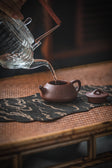
Any of them. If you brew pressed pu-erh most days, a wide-mouthed pot such as De Zhong, Han Wa or Shi Piao is the easiest to load with a chunk of cake and to empty afterwards. If you like to watch the leaves open and want a soft, steady pour, a round Xi Shi or Long Dan is a good choice. For loose, large-leaf raw pu-erh, a pear or tall pot gives the leaves room.
Choose the clay for your tea and the size for the people at your table first. Our guide to which Yixing teapot suits pu-erh covers both, and the Yixing clay guide explains Zhuni, Zini and Duanni.
Frequently asked questions
Does the shape of a Yixing teapot change the taste?
A little. Shape changes how the leaves sit and how quickly the pot pours, which affects how evenly each infusion steeps. Clay, wall thickness and size make a bigger difference, so choose those first.
What is the best Yixing teapot shape for a beginner?
A round Xi Shi or a straight-sided De Zhong. Both are comfortable to hold, pour well and are easy to load and clean.
What do Gao, Bian and Ai mean in a teapot name?
They describe how the pot differs from the classic form: Gao is tall, Bian is flattened and Ai is short. A Gao Pan is a taller Pan Hu, and a Bian Xi Shi is a flatter Xi Shi.
Why are straight-lined teapots harder to make?
Flat panels and sharp edges show every small flaw, and wide, flat bodies can sag or warp as the clay shrinks in the kiln. High-shrinkage Zhuni makes this even harder.
How can I check that a teapot's lid fits well?
Fill the pot with water, put the lid on and cover the small hole in the lid with a finger, then tip the pot. With a well-fitted lid, the flow from the spout slows or stops.
See every shape side by side in our Yixing teapot collection.


