


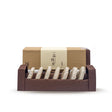
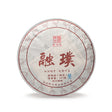
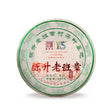
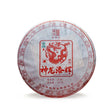



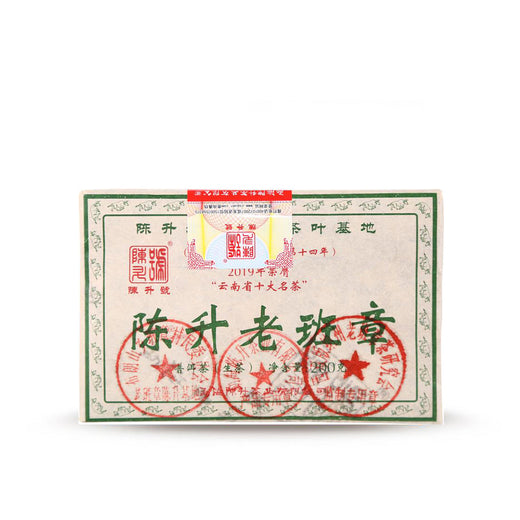


The most reliable way to tell when a pu-erh cake was made is to read it: the wrapper, the ticket pressed into the cake, the label on the bamboo tong and the box. The leaf and the liquor can then tell you whether the tea looks and tastes the age it claims. Appearance alone can't date a cake, because storage speeds aging up or slows it down. This guide covers both, using our 2018 and 2009 Emperor raw cakes as a side-by-side example.
Step 1: Read the packaging
Most producers record the year somewhere on the packaging. Check every layer before you trust your eyes.
The wrapper
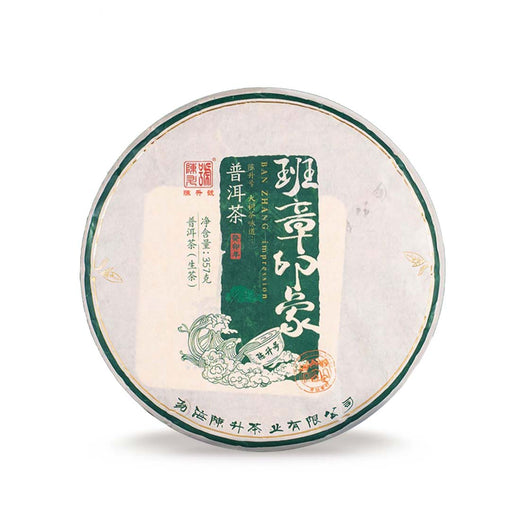
The cotton-paper wrapper around each cake is the first place to look.
- Printed year: many wrappers show the year on the front, often as part of the design or the tea's name.
- Production date and batch number: on many cakes these are printed or stamped on the back of the wrapper, sometimes with the producer's name, address, net weight and standard number. A batch number lets the producer trace the cake to a production run.
- Raw or ripe: the wrapper usually says which it is. This matters, because raw and ripe age differently and look very different at the same age.
Wrapper paper yellows slightly with age, so its condition can give a first hint. Use it as a hint only. Paper also yellows from light and handling, and a wrapper can be replaced.
The nei fei
The nei fei (内飞) is a small paper ticket placed on the leaf before pressing, so it ends up embedded in the surface of the cake. It usually carries the producer's name or mark, and some producers print the year or batch on it. Because it is pressed in with the leaf, it is hard to add or swap later without leaving a mark. Look for a ticket that sits flush in the leaf, not one glued on top.
The nei piao
The nei piao (内票) is the inner description ticket, a separate slip tucked between the wrapper and the cake. It often describes the producer, the tea and sometimes the production year. It is easy to lose or swap, so read it together with the wrapper and nei fei.
The tong and the box
Cakes are traditionally sold in a tong (筒) of seven, wrapped in bamboo leaf, and several tongs are packed in a basket or box. Tong labels and outer boxes often carry the production date and batch number too. If you buy a full tong or an original box, the dates on the outer packaging should agree with the cakes inside.
If the dates on different layers don't agree, or there is no date anywhere, ask the seller where the cake came from before you rely on any age claim.
Step 2: Look at the leaf and the liquor
Once you know the claimed year, check whether the tea looks and tastes that age. These clues apply mainly to raw (sheng) pu-erh. Ripe (shou) pu-erh is dark from the start, so its color changes much less; it mellows and loses its pile smell over the first few years.
| Clue | Young raw pu-erh | Aged raw pu-erh |
|---|---|---|
| Dry leaf | Green to dark green, often with visible downy tips (显毫) | Reddish-brown to brown; the downy tips turn tawny |
| Liquor color | Pale yellow to yellow or golden | Orange-yellow, then orange-red, deepening toward red over many years |
| Aroma | Fresh, floral or floral-honey | Aged aroma (陈香), sometimes woody |
| Taste | Strong; bitterness that turns quickly to huigan | Smooth and mellow, with aged character (chen yun 陈韵) |
| Infused leaf | Bright yellow-green | Brown to reddish-brown |
The honest caveat: storage changes the speed
Two cakes from the same year can look years apart. Warm, humid storage darkens leaf and liquor faster; dry or cool storage keeps a cake looking young for longer. Poor storage can also make a tea look older than it is while spoiling its taste. So appearance can tell you whether a claim is plausible, but it can't give you a year. A cake sold as twenty years old that brews a pale yellow, fresh-tasting liquor deserves questions. A cake that looks very dark for its stated age may have been stored hot and wet, or may not be what it claims.
A side-by-side example: our 2018 and 2009 Emperor
Our Emperor raw cake (Ba Wang Qing Bing) has been made every year since 2009, which makes it a useful comparison.

| 2018 Emperor | 2009 Emperor |
|---|---|
| Tight, sturdy leaves with plenty of downy buds. The dry leaf smells clean and fragrant. The liquor is bright golden with a clear, high aroma. The taste is strong and thick: the bitterness is solid but fades quickly, followed by strong salivation and a lasting sweet aftertaste (huigan). The infused leaves are plump, glossy and supple. | The dry leaf has a low, deep aroma with no off-odors. The liquor is a bright orange-yellow with a clear aged aroma. The taste is mellow, with a deep bitterness underneath and strong cha qi, a good sweet aftertaste and a long, lingering aged character. The infused leaves are glossy, even and clean. |

Nine years apart, the difference is clear in the liquor and the infused leaf. Under different storage, the same two cakes could look closer together or further apart.
How to buy aged pu-erh with confidence
- Buy from the producer or a seller you trust. A producer can tell you when the tea was made and how it has been stored. Ask about storage conditions for any aged cake.
- Check that all the packaging agrees: wrapper, nei fei, nei piao, tong label and box.
- Compare with a known cake. Brew a cake whose year you are sure of next to the one you are unsure about, with the same leaf weight, water and timing. The difference is easier to read side by side than from memory.
- Brew it fairly. Use water just off the boil (100°C / 212°F), about 5–7 g in a 100–120 ml gaiwan, a quick rinse, then short infusions of 5–10 seconds.
- Be wary of age claims without paperwork, especially when the price looks low for the age.
For more on how raw pu-erh changes over time, read how aging changes pu-erh, and to judge any cup, use our tasting vocabulary.
To taste age for yourself, browse our aged pu-erh collection.


