







Yixing Teapot Guide
A Yixing teapot is a small, unglazed clay pot that holds heat well and, with use, seasons to the tea you brew in it. Choosing one comes down to three questions: which tea you drink most, how many people you brew for, and which shape feels right in your hand. This guide walks through each one and links to the pots and articles that go deeper. In a hurry? Answer three questions in our Teapot Finder.
1. Match the clay to your tea
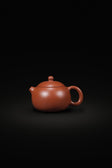
- Mostly young raw pu-erh: choose Zhuni (vermilion clay). It is dense, keeps aroma clean and bright, and pours fast for short infusions. If your raw pu-erh is very bitter, a sandy, breathable Duanni pot softens the edges.
- Mostly ripe pu-erh or aged raw pu-erh: choose Zini or another purple clay, such as Tianqing Ni or Jiangpo Ni. These clays hold steady heat and round out the liquor.
- Both raw and ripe: keep two pots, one for each, because the clay slowly takes on the character of what you brew.
Or start from the tea: teapots for raw pu-erh · teapots for ripe and aged pu-erh.
2. Pick the size
| Size | People | Leaf (approx.) |
|---|---|---|
| Up to 140 ml | 1–2 | 6–8 g |
| 150–180 ml | 2–3 | 9–11 g |
| 200 ml and up | 3 or more | 12 g and up |
Leaf amounts follow our house gongfu ratio of about 5–7 g per 100–120 ml. If you are not sure, start with 150–180 ml.
3. Choose a shape
Yixing shapes have names that go back centuries. Shape affects how the leaves open and how the pot pours, but within a size and clay, choose the one you like to hold and look at.
- Round shapes such as Xi Shi, Long Dan (dragon egg) and Wen Dan give the leaves room to open evenly and pour smoothly.
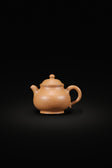
- Tall and pear shapes such as Pan Hu, Li Xing (pear), Gao Pan and Shui Ping suit rolled or tightly pressed leaves that need space to unfurl.
- Straight-lined shapes such as Shi Piao, De Zhong, Han Wa, Qin Quan and Xu Bian have clean geometric lines and are favorites with collectors.
Every shape we carry, with what its name means: Yixing teapot shapes guide.
How to care for your pot
- Season a new pot with a few hot-water rinses and two or three rounds of the tea you plan to brew.
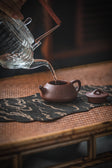
- Brew with water just off the boil (100°C / 212°F) for raw and ripe pu-erh alike.
- Rinse with hot water only. No soap, no dishwasher, no stove.
- Dry it fully with the lid off, and keep it away from strong smells.
Full steps: how to season and care for a Yixing teapot.
Our Yixing teapots
Every pot in our collection is fully handmade in Yixing. Each listing names the clay, the capacity and the pu-erh it suits best, so you can compare pots side by side.
Read more
- How to choose your first Yixing teapot
- Which Yixing teapot for pu-erh? Raw, ripe and aged
- Zhuni, Zini or Duanni? A guide to Yixing clays
- Yixing teapot shapes: Xi Shi, Shi Piao, De Zhong and more
- Handmade, half-handmade or mold-made?
- How to season and care for a Yixing teapot
- Gongfu brewing, step by step