







A fully handmade Yixing teapot is built from flat slabs of clay that the potter beats into shape with a wooden paddle, without a mold. A half-handmade pot is formed by pressing clay slabs into a plaster mold, then finished and assembled by hand. A mold-made or slip-cast pot is shaped mostly by molds or machines, often with a liquid clay slurry poured into the mold. All three can brew well. What changes is the skill and time behind each pot, the clay that can be used and the price.
The three main methods
| Method | How the body is made | What it means for you |
|---|---|---|
| Fully handmade (全手工) | Clay is beaten into thin slabs. A strip is wrapped into a ring for the body, and the potter shapes it by tapping with a wooden paddle on a turntable. Spout, handle, lid and knob are shaped and joined by hand. | Each pot takes a day or more of a trained potter's time. Small differences from pot to pot are normal. Usually the most expensive. |
| Half-handmade (半手工) | Clay slabs are pressed into a plaster mold to form the body, then the potter joins the parts and finishes the surface by hand. | Very consistent shapes, and the clay is the same kind used for handmade pots. A good, honest choice at a lower price. |
| Mold-made or slip-cast | The body is shaped by a machine in a mold, or liquid clay slurry is poured into a plaster mold and left to set. | Fast to produce in large numbers and the least expensive. Slip-casting needs a very fluid clay, so the clay is often blended or altered. |
Within handmade work, potters also distinguish wheel-thrown pots, which are uncommon in Yixing because zisha clay is not very plastic, and fully hand-built pots, which is what "fully handmade" means in a Yixing listing.
How a handmade pot is built
- Preparing the clay. Raw ore is weathered, ground, sieved, mixed with water and left to rest before it is ready to shape.
- Beating the slabs. The potter pounds the clay into flat sheets of even thickness with a heavy wooden mallet.
- Forming the body. A long strip is wrapped into a ring and joined. The top and base are added as round discs, and the potter taps the walls from the outside with a paddle while a hand supports them from inside, slowly turning the ring into the final shape.
- Adding the parts. Spout, handle, lid and knob are made separately and attached with slip, then all joins are smoothed.
- Finishing and firing. The surface is burnished with tools of horn or bamboo, the maker's seals are stamped, and the dried pot is fired without glaze.
How to tell them apart
No single sign is proof, because skilled makers of every method smooth away their tool marks, and seams and seals can be imitated. Taken together, these hints help:
- The inside seam. Look inside the body, opposite the handle. A fully handmade pot often shows a faint vertical line where the clay strip was joined. Half-handmade pots may show mold seams instead, often running down the sides.
- Marks inside. Handmade pots usually show a few irregular tool marks inside. Many small, uniform marks or a very smooth, even interior suggest a mold.
- Symmetry. Very sharp, machine-like symmetry suggests a mold. A slight, natural variation suggests hand work, though a good potter can make a pot very even by hand.
- Seals. Traditional handmade pots often carry seals inside the lid, under the handle and on the base. Seals show who made or signed the pot, not how it was made.
- Weight and feel. A slip-cast pot made from an altered clay can feel lighter and look less porous than a pot made from natural zisha.
The most reliable sign is a seller who states the method and the clay clearly for every pot.
Does the method change the tea?
The clay, the wall thickness and the size of the pot shape the cup more than the method does. A well-made half-handmade pot in good clay brews better than a poorly made handmade one. Where the method does matter is the clay itself: pots made by hand or with press molds use clay that can be shaped as a stiff slab, while slip-casting needs clay thinned into a liquid, which often means a blended clay that behaves differently in the pot.
What we sell
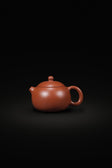
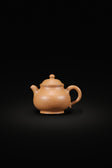
The Yixing teapots in our collection are fully handmade. Each listing names the clay, such as Original Ore Zhuni, Xiao Mei Yao Zhuni, Zini, Tianqing Ni, Jiangpo Ni or Duanni, along with the capacity and the pu-erh it suits best. Because every pot is shaped by hand, small differences from the photos in color, surface and proportion are normal.
Frequently asked questions
Is a half-handmade Yixing teapot fake?
No. Half-handmade is a traditional method that uses the same kind of clay as fully handmade pots. It is a different way of shaping the body, and a good half-handmade pot can brew very well.
Why do fully handmade Yixing teapots cost more?
Each one takes a trained potter a day or more, and some clays, such as Zhuni, are hard to shape by hand because they shrink a great deal in the kiln. Fewer pots, more skill and more time all add to the price.
Can you tell a handmade teapot from the inside seam alone?
Not reliably. The seam opposite the handle is a common sign of a hand-built body, but it can be smoothed away or imitated. Look at several signs together and buy from a seller who states the method.
Are slip-cast Yixing teapots safe to use?
A pot from a reputable maker is made to be used for tea, whatever the method. Slip-cast pots are often made from blended clay, so they may not take on tea oils and build a patina in the same way.
Do maker's seals prove a pot is handmade?
No. Seals show who made or signed a pot. Molded pots can carry seals too, and well-known seals are often copied.
Ready to choose? See how to choose your first Yixing teapot or browse our handmade Yixing teapots.


