





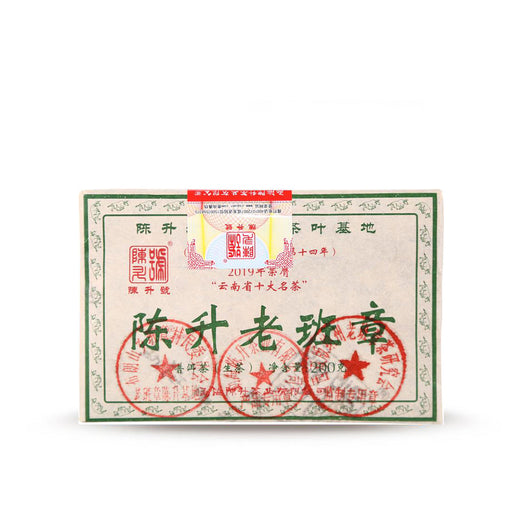


What is Lao Ban Zhang?
Lao Ban Zhang (老班章) is a village on Bulang Mountain in Menghai County, Xishuangbanna, in Yunnan Province, China. The village is famous for one thing: its raw pu-erh, often called the "King of raw pu-erh".
Lao Ban Zhang raw pu-erh is one of the best-known and most expensive pu-erh teas in the world. It is strong and thick, with a pronounced bitterness that turns quickly into huigan (sweet aftertaste), and strong cha qi. The village can only produce a limited amount each year, and demand far exceeds supply, which is why prices are so high.
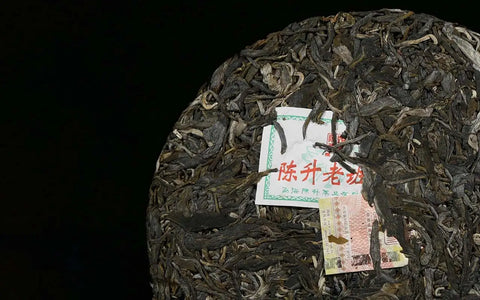
The Old-Arbor Tea Gardens of Lao Ban Zhang
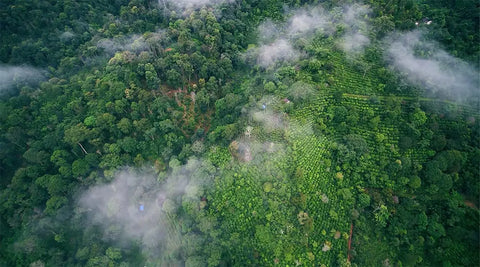
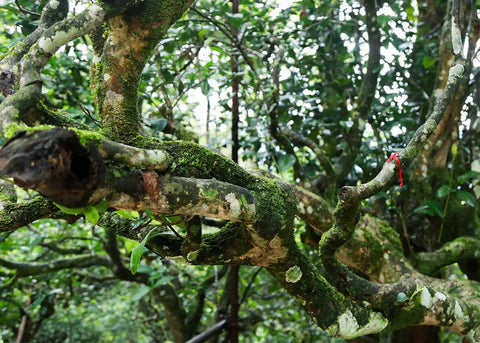
Much of Lao Ban Zhang's quality comes from where it is. The village sits deep in the Bulang Mountain area, far from any city, surrounded by remote, well-preserved forest. The gardens are part of a layered forest, with tall trees, tea trees and undergrowth growing together, which suits the tea trees well.
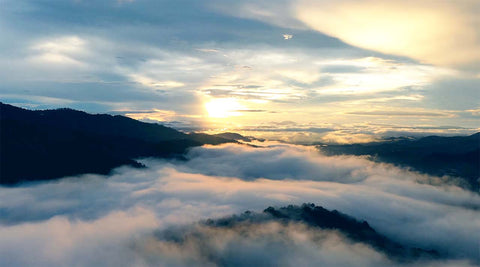
A Chinese saying goes "high mountains and mist make good tea" (高山云雾出好茶). High on Bulang Mountain, Lao Ban Zhang has large differences between day and night temperatures, moderate sunlight and high humidity. Thick mountain mist also shades the leaves from strong direct sun, which helps their aroma and flavor.
The area keeps its original vegetation, with rich soil, plenty of sunshine, thick fog and high humidity: good conditions for old-arbor tea trees. The soil is a slightly acidic red soil with a deep layer of organic matter and minerals.
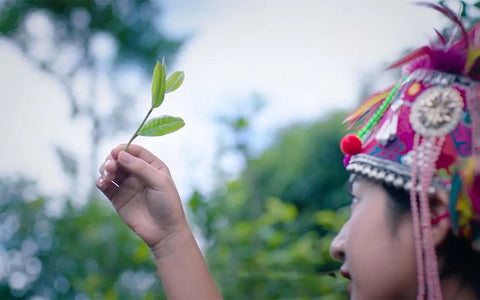
For generations, the villagers of Lao Ban Zhang have tended their old-arbor tea trees, picked the fresh leaves by hand and sun-dried them. They still manage the gardens this traditional way today.
The 2007 Pu-erh Market Crash
In spring 2007, the pu-erh market rose and fell sharply in a short time, and many tea companies lost money. The price of Lao Ban Zhang maocha rose steeply and then collapsed.
The speculation built up in three stages. Before 2005, traders from Hong Kong and Taiwan led the market, buying up aged tea and pushing up the price of young tea. Next, mainland distributors, facing a shortage, ordered large amounts of tea from factories, which brought many neglected tea gardens in Yunnan back into production. Finally, speculators used auctions and other methods to hype the market further, and distributors hoarded tea. When prices peaked, the speculators pulled out, and those left holding tea took heavy losses. Tea farmers were hit hard too.
Lao Ban Zhang and Chen Sheng Hao
Today, when many people hear the name Lao Ban Zhang, the first producer that comes to mind is Chen Sheng Hao.
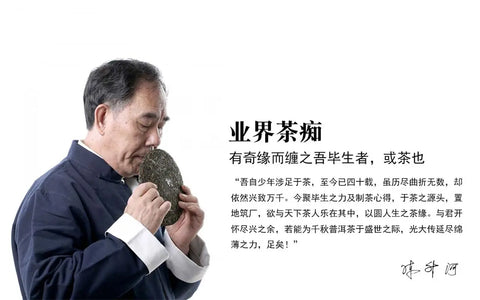
Our founder, Shenghe Chen (陈升河), began working in tea in Shantou in 1973. In 2006 he spent two months traveling through Yunnan's tea regions, and in 2007 he founded Chen Sheng Hao in Menghai. Chen Sheng Hao is the pu-erh brand of the Menghai Chen Sheng Tea Co.
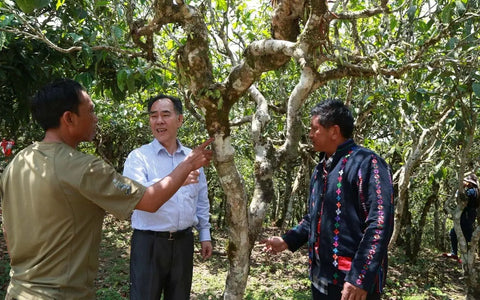
On that journey, he felt that Yunnan pu-erh had no representative brand and that farm-level processing had no common standard. When he visited Lao Ban Zhang and talked with the villagers, they told him they hoped he would take on the village's tea. Most of the village shared that wish.
The 2007 crash had badly hurt the farmers' income. Shenghe Chen felt a company had a responsibility to protect the farmers, keep the market stable over the long term, and secure high-quality maocha for its own tea. So in 2007 he bought the farmers' unsold 2007 harvest, more than 10,000 kilograms, for millions of yuan.
With the support of the local government, the village then looked for a way to work with a company over the long term. With the approval of the Menghai County government and the agreement of almost all the villagers, Menghai Chen Sheng Tea Co. and Lao Ban Zhang village signed a 30-year cooperative purchasing and sales agreement in 2008, creating the "Chen Sheng Lao Ban Zhang" brand together. That same year, Shenghe Chen's son, Chen Liubin, joined his father in the business.
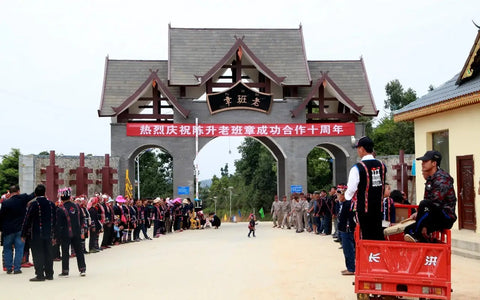
Under the agreement, the village group provides land free of charge, and Chen Sheng Hao pays to build and run the Lao Ban Zhang first-processing base in the village. In return, Chen Sheng Hao holds the exclusive legal right to sell all Lao Ban Zhang pu-erh produced by the village group.
For the length of the agreement, the village group sells all of its fresh leaf to the base each year and follows agreed rules for how the gardens are tended. The price is negotiated between the two sides, using the market price as a reference. The villagers gain a stable income, and we gain a reliable source of genuine Lao Ban Zhang leaf. This is the "company + base + farmers" model.
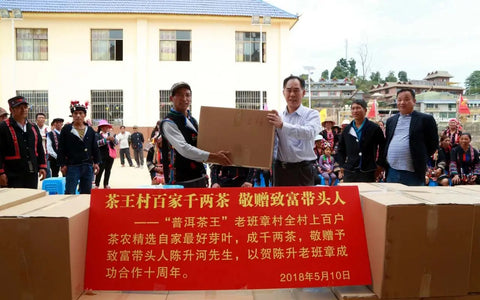
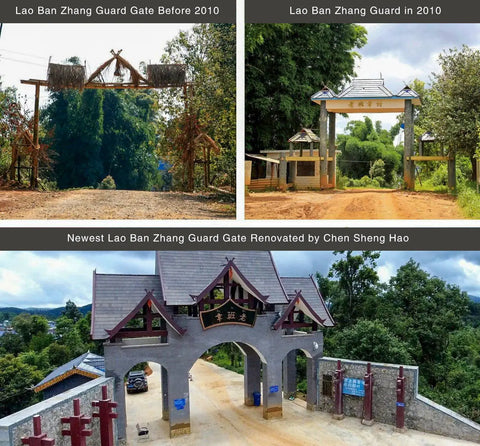
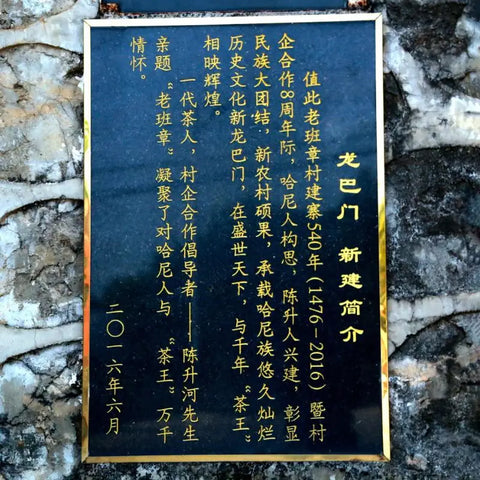
The partnership is about more than money. Over the years, Chen Sheng Hao has funded the road into Lao Ban Zhang (built in 2009), rebuilt the village's third-generation Long Ba Gate, and helped fund a village clinic, among other projects.
Protecting the Real Lao Ban Zhang
Lao Ban Zhang produces only a small amount of old-arbor tea each year, yet tea sold as "Lao Ban Zhang" floods the market every year. In the past, some villagers chasing higher profits brought plantation tea from the Menghun basin into the village and sold it as Lao Ban Zhang.
Our processing base in the village lets us control the source of the leaf and keep quality stable. To protect the name, the village has also drawn up its own rules: villagers take turns guarding the village gate every day to stop outside tea from coming in, and a supervisory team set up by the village committee keeps watch 24 hours a day. This is a key part of how the village and our company guarantee the tea together.
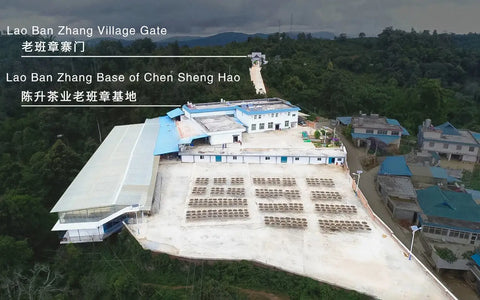
Processing was another problem. Many farmers used to carry fresh leaf in old fertilizer bags, which could contaminate it. They often spread the leaf on the ground to dry, which was unhygienic and poorly ventilated: the top layer dried too much in the sun while the bottom stayed damp. On rainy days some farmers dried the leaf over a fire, which gave it a smoky taint. There was no common processing standard, and leaf quality varied widely.
Good leaf alone does not make good tea. Picking, withering, drying and pressing each decide the quality of the final cake. Without strict standards, a tea does not deserve the Lao Ban Zhang name.
So our Lao Ban Zhang base built a modern withering shed, along with rooms for the boiler, withering, pressing, drying, packing and storage. This raised the processing standard for Lao Ban Zhang tea considerably.
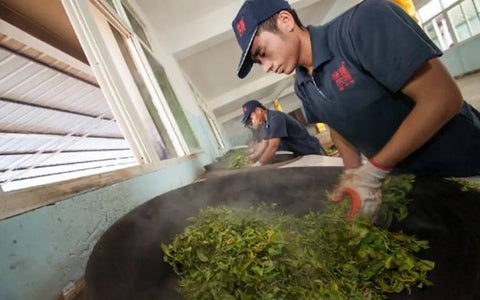
To replace the fertilizer bags, we had double-layer, moisture-proof woven bags made for every household in the village. When farmers bring fresh leaf to the base, our staff check its quality, sort and weigh it, and spread it straight away on bamboo mats. The leaf is then withered and processed in a clean withering area with multi-level racks and screens against flies and insects.
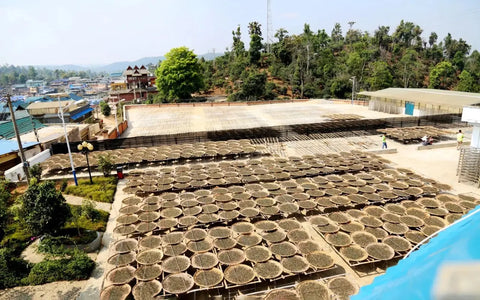
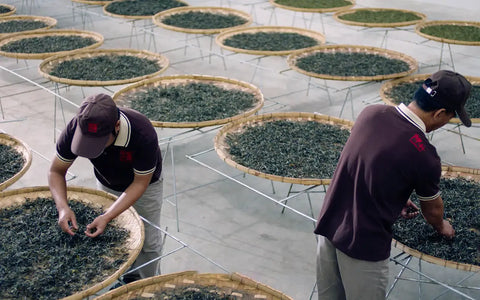
To protect the old-arbor trees, we invited tea experts to the village to work with the farmers. They showed them how to pick without harming the trees and to harvest only twice a year. They also shared green pest-control methods and donated insect traps and insect-killing lamps for the gardens. This reduces damage to the buds and keeps yields stable without harming the natural ecology of the gardens. Our message to the farmers is simple: only by protecting these trees can Lao Ban Zhang tea keep its place in the world.
How to Recognize Real Lao Ban Zhang Pu-erh
Leaf
Lao Ban Zhang pu-erh is made from fresh leaf of large-leaf tea trees in the old-arbor gardens of Lao Ban Zhang village. Our Lao Ban Zhang uses single-origin leaf from old-arbor trees, so you taste the pure character of the village.
Dry leaf
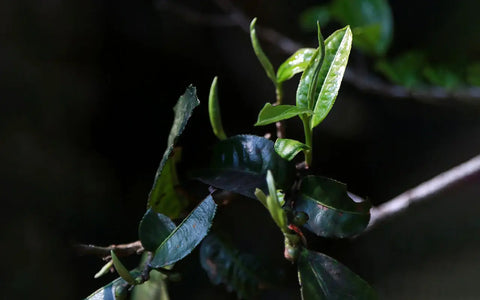
The dry leaf is a glossy dark green. The leaves are large, plump and sturdy, with serrated edges, and the buds are thick and visibly downy.
Aroma of the cake
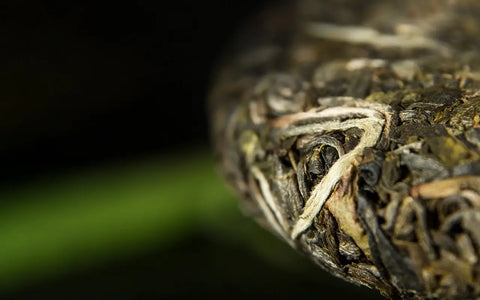
You can smell the tea before you break the cake. When you open the cotton paper wrapper, a woody, mountain aroma comes through clearly.
The old-arbor trees of Lao Ban Zhang are deeply rooted. In the gardens you would struggle to find a stone in the ground; the soil has built up from fallen leaves year after year. This naturally formed soil is part of what gives Lao Ban Zhang its woody aroma.
Aroma in the cup
Lao Ban Zhang leaves its aroma on the cup. Lift the empty cup and smell it: the woody, mountain aroma comes first, then slowly turns into a floral-honey aroma, like honey and orchids. A light sweetness follows on the tongue.
The aroma tends to arrive suddenly and pass quickly, so it rewards slow, attentive tasting.
Liquor color
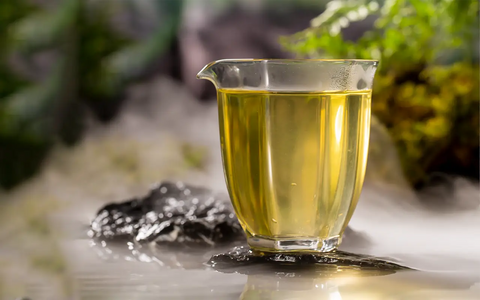
After the second infusion, pour the liquor into a fair cup (pitcher) to look at the color.
The color changes with age. Within the first three years, the liquor is a clear, bright yellow. As the tea ages naturally, it slowly deepens: after a few years in dry storage it moves toward orange-yellow, and after more than five years it begins to turn orange-red. Tea stored for a long time turns red, less bright but with an oily sheen, and the liquor feels thicker and more mellow.
Taste
Some drinkers describe Lao Ban Zhang as bitter, others as astringent. Both are part of what makes it the "King of raw pu-erh".
But a tea that was only bitter and astringent would not be a good tea. In Lao Ban Zhang, the bitterness carries a hint of sweetness and the astringency carries a lasting aroma. After you swallow, the bitterness and astringency fade quickly, leaving a sweetness that stays in the throat for a long time. Tea drinkers call this throat feel (hou yun, 喉韵), and it is the "kingly" quality people look for in Lao Ban Zhang.
Old-arbor Lao Ban Zhang is also very durable: good spring tea can be brewed more than twenty times. Spring tea shows its character best.
Lao Ban Zhang has held its title for a long time. It is called "king" because of how strongly it fills the mouth from the first sip, its strong bitterness that turns into a long sweet aftertaste, and its strong cha qi (茶气). Many drinkers describe cha qi as a warming, energizing feeling that builds over several cups.
Infused leaves
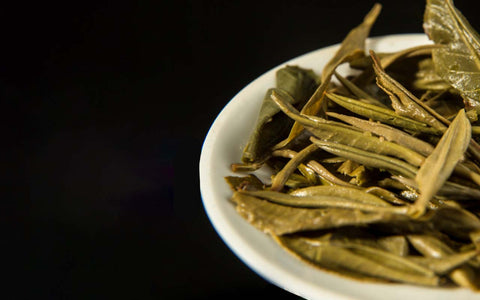
After many infusions, tip the leaves onto a tray and look at them. The leaves are plump and sturdy, the buds are large, and the white down is easy to see.
Pick up a whole leaf. It feels soft and supple, yet resilient: rub it between two fingers and it slides without tearing. Wrap a whole stem around your finger and it bends like a rubber band without snapping.
Where to Buy Genuine Lao Ban Zhang
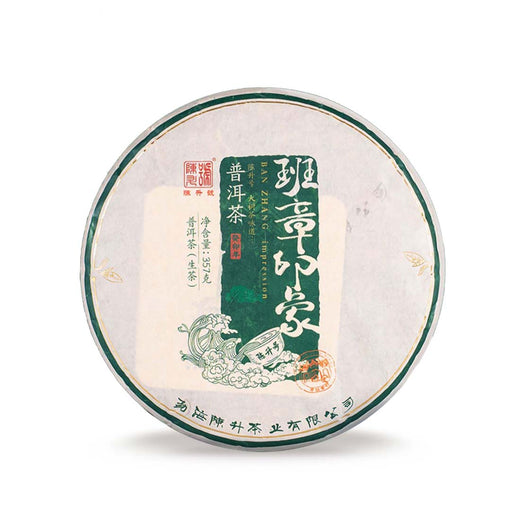
Chen Sheng Lao Ban Zhang is jointly guaranteed by three organizations: the Lao Ban Zhang Group of the Ban Zhang Village Committee, Bulang Mountain Township, Menghai Chen Sheng Tea Co., and the Lao Ban Zhang Tea Farmers Association of Bulang Township, Menghai County. Their three red round seals are printed on the cotton paper wrapper. The three seals have become the classic mark of Chen Sheng Lao Ban Zhang: each cake can only be produced once all three have approved it.
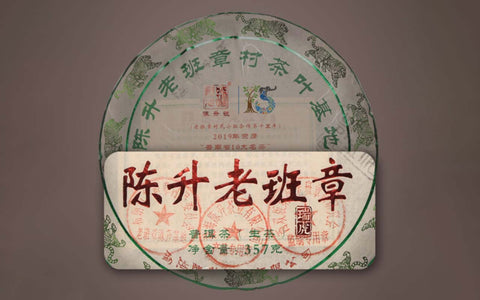
See our current cake: 2022 Chen Sheng Lao Ban Zhang raw pu-erh. To learn more about the village, visit our Lao Ban Zhang base or read sixteen years with Lao Ban Zhang.
An independent review of our 2022 Lao Ban Zhang
TeaDB, an independent tea review channel, tasted our 2022 Lao Ban Zhang on YouTube:
To compare years and pressings, browse our Lao Ban Zhang collection.


