






Buy your weekday smoothies and get your weekend ones for free. (7 for the price of 5!)
WELLNESSWEEK
Taste a few styles before you commit to a full cake.
Reliable cakes to brew at home, morning to evening.
Old-arbor single-origin cakes and aged pu-erh to drink or keep.
The house blends and annual releases Chen Sheng Hao is known for.
Handmade Yixing teapots in small gongfu sizes.
Clear glass sets that let you watch the leaves open.
Compact gongfu sets that pack into a bag.
Guides to brewing pu-erh and caring for your teapot.


陈升号 · Newsletter
Join our newsletter and we'll send you four short letters, a few days apart:
After that, you'll be the first to hear about new teas and limited releases.
陈升号 · Newsletter
Your first letter, the story behind our tea, is on its way. If it isn't in your inbox in a few minutes, please check your Promotions or Spam folder.

Most pu-erh is pressed into a shape: a round cake (bing cha), a brick (zhuan cha), a small bowl (tuocha), a melon (jin gua) or bite-sized pieces. The shape doesn't change what the tea is. The same leaf can be pressed into any of them. Shape mostly affects how easy the tea is to store, carry and break apart, and, to a modest degree, how quickly it changes with age.
Pressed tea takes up less space and travels well. For centuries, tea from Yunnan was carried by horse and mule along the Tea Horse Road, and compact cakes and bricks survived the journey far better than loose leaf. Pressing is still standard today because it makes the tea easy to store and keeps it together while it ages.
After processing, the dry leaf (maocha) is weighed, softened with steam, put into a cloth bag and pressed by a stone or machine press. The tea is then dried slowly before wrapping.
| Shape | Typical weight | Good to know |
|---|---|---|
| Cake (bing cha) | 357 g; also 100–500 g | The classic format. Seven cakes make one tong. |
| Brick (zhuan cha) | Often 250 g; up to 1 kg | Rectangular and usually pressed hard. |
| Tuocha | Often 100 g or 250 g; mini tuocha 5–10 g | Bowl-shaped, dense in the middle. |
| Jin gua (golden melon) | From 100 g to several kilograms | Round melon shape linked to the tribute tea tradition. |
| Mini cakes, dragon pearls, loose maocha | A few grams to about 200 g | Convenient for one session; no breaking needed. |
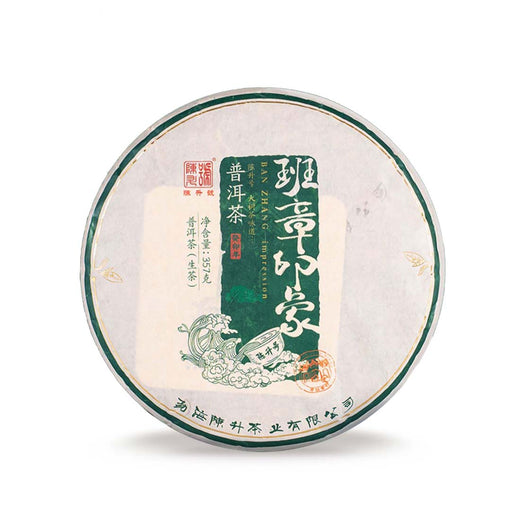
The round cake is the format you will see most. The standard weight is 357 g. Seven cakes are stacked and wrapped in bamboo leaf to make one tong (about 2.5 kg). Each cake has its own paper wrapper, and the underside usually has a small dimple from the cloth bag. Cakes are easy to store, easy to stack and reasonably easy to break with a pick. Most of our raw pu-erh, including Chen Sheng #1, comes as cakes.
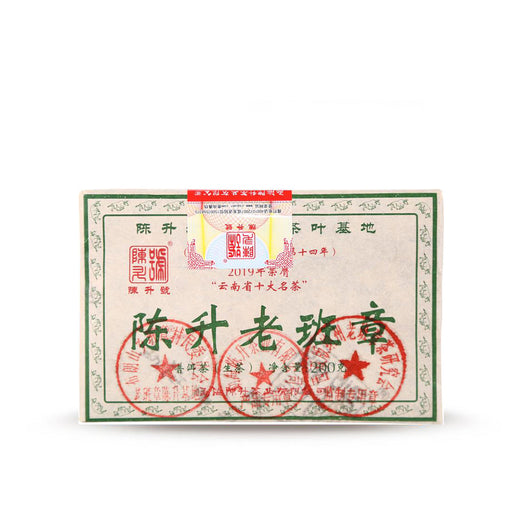
Bricks are rectangular and often pressed harder than cakes. They pack neatly in a box, and the edges make a good place to start breaking. Because they are dense, take your time and work off thin layers rather than chunks.
Tuocha is shaped like a small bowl or nest: domed on top with a hollow underneath. The center is the densest part. Larger tuocha (100 g or 250 g) need a pick. Mini tuocha are pressed for a single pot and go straight into the gaiwan.
Jin gua (golden melon) is pressed into a round shape with ridges, a little like a pumpkin. The format is associated with the pu-erh sent as tribute tea to the Qing court. Today it is made in many sizes, often as a display piece or gift. It is hard to break because it is thick all the way through.
Many cakes carry two small pieces of paper from the maker:
Keep both with the cake. They are part of how you tell what you have. Our guide to identifying the production year explains how to read the wrapper and tickets.
Use a pu-erh pick or a dull, blunt-tipped knife, not a sharp kitchen knife. Always push the blade away from the hand holding the tea.
Step-by-step photos are in how to break and rinse a pu-erh cake. Whatever the shape, brew with water just off the boil and follow our gongfu brewing guide.
A little. Tighter pressing and bigger, thicker pieces change more slowly, because less of the leaf is exposed to air. A tightly pressed brick or jin gua will usually change more slowly than a cake of the same tea, and a cake more slowly than loose leaf. The tea itself and the storage conditions matter far more than the shape.
Whatever the shape, store it the same way: in its wrapper, in a box, somewhere dark and odor-free at about 20–25°C (68–77°F) and 60–70% humidity. Don't put pu-erh in the fridge. It is too cold and full of food smells, and it stops the tea from changing. See how to store pu-erh tea for the full guide.
Want to try a few teas before buying a full cake? Browse our tea samples.
This article is general information about tea, not medical advice. If you're pregnant, breastfeeding, taking medication or managing a health condition, please talk to your doctor before changing what you drink.

Every tea page at cspuerh.com now has tasting reviews. Score a tea on the five factors from the Pu'er Tea Association's 2026 standard, get a weighted score out of 100, and describe it with 95 defined tasting words. Simple mode takes about three minutes.

The 95 tasting terms in the Pu'er Tea Association's 2026 quality standard, in English and Chinese — aroma, liquor color and taste, plus how the standard scores a pu'er.

What really drives pu-erh prices, from mountain fame and old-arbor leaf to processing and years of storage, and how to find good value without overpaying.

Shop our premium Pu Erh tea collection—available in both ripe and raw varieties! Pu-erh tea, a beloved fermented variety from...

Shop our Pu Erh tea collection, available in both ripe and raw varieties! Pu erh tea, with its rich history...

Shop our premium Pu Erh tea collection—available in both ripe and raw varieties! In the misty mountains of Yunnan Province,...